




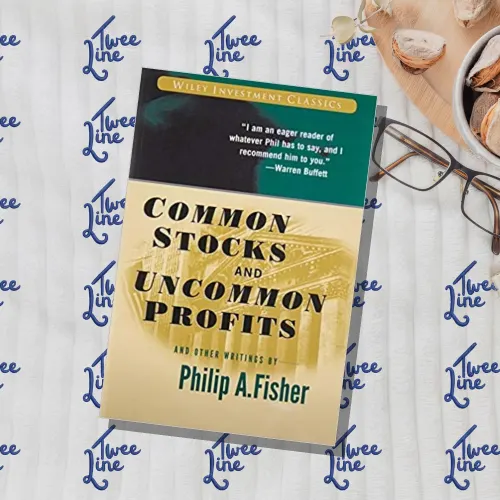
Common Stocks and Uncommon Profits and Other Writings
A practical paperback pick for readers drawn to personal growth and useful action in Common Stocks and Uncommon Profits and Other Writings.
Non-Fiction
Rs. 12,790.00
Sri Lankan goods, delivered to your door
Join Join our WhatsApp channelA practical paperback pick for readers drawn to real-world ideas, context, and perspective in Paths to Wealth Through Common Stocks.
Out of stock
Paths to Wealth Through Common Stocks by Philip A. Fisher offers real-world insight, context, and thoughtful ideas. It is a solid choice for readers looking for a clear, useful, and easy-to-follow book.
P By Philip A. FisherOut of stock — get notified
Leave your email and we'll let you know the moment it's back.
At its core, Paths to Wealth Through Common Stocks is designed to give readers a direct path into a topic that matters to them. Written by Philip A. Fisher, Paths to Wealth Through Common Stocks sits within the Economics shelf and naturally connects to the broader idea of real-world ideas, context, and perspective. The title suggests a straightforward promise, and the book delivers that promise with a tone that is meant to be readable rather than remote. It is the sort of book that can be read for information, perspective, or simple enjoyment, depending on what the reader is hoping to get from it. Paths to Wealth Through Common Stocks by Philip A. Fisher is built around a central idea that can be explained in plain language and then carried into daily reading habits.
The book's appeal comes from its ability to take a familiar subject and present it with enough clarity that the reader can follow along without effort. The source material points toward a book that is meant to inform, guide, and encourage reflection, which gives it value beyond a simple quick read. In that sense, it works as both a topic-driven book and a useful companion for someone who wants to understand the subject in a calmer, more deliberate way. The product copy points to a book that speaks clearly about its subject, with a tone that is informative and easy to approach. One of the strongest things about Paths to Wealth Through Common Stocks is the way it keeps attention on a single direction instead of scattering the reader across too many ideas at once.
That focus makes it easier to understand the main point, see how the ideas connect, and remember what matters after the final page. For readers who like to feel progress while they read, that structure can be especially satisfying because it gives each section a sense of purpose. The book is also suitable for readers who want something they can revisit later, since the ideas tend to work best when they are absorbed steadily rather than rushed. Its economics placement helps frame the reading experience and gives the book a clear place on the shelf. The overall feeling is one of steady movement, where each part contributes to a larger picture of real-world ideas, context, and perspective. The reading experience of Paths to Wealth Through Common Stocks depends on the kind of mood the reader brings to it, but it generally rewards attention, patience, and a willingness to think as you go.
That makes it a strong choice for readers who like books that feel useful after the cover is closed, not just while the pages are turning. The structure is easy to imagine as something that can be read in sections, reflected on between sessions, and revisited when a specific idea feels relevant again. This tends to make the book feel less like disposable content and more like a reference point that can stay on a personal shelf for a long time. This edition is paperback, published by John Wiley & Sons, published in August 2007, 240 pages. With 240 pages, it has enough room to develop its ideas without feeling overstretched. Anyone drawn to books that mix insight with accessibility should find Paths to Wealth Through Common Stocks easy to settle into. Instead, it stays focused on its topic and gives the reader a consistent path through the material.
For someone who is browsing with intention, that kind of clarity can make the difference between a book that gets skimmed and a book that gets finished. It is also a sensible pick for readers who want to give a thoughtful gift, because its subject matter usually has a practical or emotional relevance that is easy to explain. When the category leans toward economics, the book tends to feel even more relevant to readers who are already interested in that shelf. That relevance gives it a lasting place in a collection that values purpose, usefulness, and readable ideas. Taken as a whole, Paths to Wealth Through Common Stocks feels like a book with a clear point of view and a useful reason to exist. It does not rely on noise or confusion to hold attention, and that is part of what makes it appealing.
Instead, it offers a dependable reading experience that is centered on real-world ideas, context, and perspective and delivered in a format that is easy to approach. For readers looking for something that belongs in the Economics section of a catalogue, it offers a simple, memorable promise. The result is a book that can be recommended with confidence to readers who want substance, clarity, and a steady sense of direction. That combination gives it value for browsing, buying, reading, and returning to later when the same subject comes back into focus. The title Paths to Wealth Through Common Stocks also carries commercial appeal because it is easy to remember and easy to recommend. That matters in a catalogue where readers often decide quickly whether a book feels right for them.
This book gives a clear answer by presenting a topic that feels organized, approachable, and easy to place within a reading list. For anyone building a personal library, it is the kind of title that can sit alongside other strong picks without feeling out of place.
Philip A. Fisher (1907-2004) was an influential American investor and author, best known for his pioneering work in growth stock investing. His book 'Common Stocks and Uncommon Profits' (1958) is considered a classic in investment literature. Fisher's investment philosophy emphasized in-depth research and long-term holding, influencing later investors like Warren Buffett.
A practical paperback pick for readers drawn to personal growth and useful action in Common Stocks and Uncommon Profits and Other Writings.
Non-Fiction
A woman needs money and a room of her own to write fiction.
Non-Fiction
The 1848 pamphlet that reframed history as class struggle.
Non-Fiction
Your cart is empty
Start adding items to see them here.