




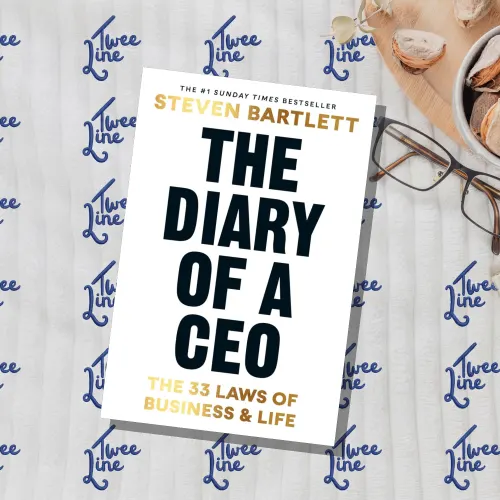
The Diary of a CEO: The 33 Laws of Business and Life
A practical paperback pick for readers drawn to personal growth and useful action in The Diary of a CEO: The 33 Laws of Business and Life.
Steven Bartlett
Rs. 4,390.00
Sri Lankan goods, delivered to your door
Join Join our WhatsApp channelSharp, honest lessons on business and life from a founder who built and lost and built again.
In stock
A candid collection of hard-won lessons on leadership, decision-making, and personal growth from Steven Bartlett, host of The Diary of a CEO podcast.
Why read it
— Twee Line's take
Ask Tweeny about this book
The Diary of a CEO is a book built around the idea that the most useful business and life lessons are the ones people rarely say out loud. Drawing on the conversations and experiences behind the popular podcast of the same name, it turns big, messy questions about work, ambition, failure, and fulfilment into something a reader can actually use. It is not a memoir in the traditional sense and it is not a dry management textbook. It sits somewhere in between: part reflection, part field guide, part challenge to the way many people quietly run their careers and their lives.
The book is organised around the kind of topics that come up again and again when high performers are asked what really matters. How do you make decisions when the information is incomplete? What does it take to build something from nothing? Why do smart people keep repeating the same mistakes? How do you handle failure without letting it define you? And perhaps most importantly, how do you define success for yourself rather than borrowing someone else's definition? Each chapter works as a standalone idea, but together they form a coherent argument about what it takes to think clearly and act deliberately over a long period of time.
At its core, The Diary of a CEO is about the gap between how success looks from the outside and how it actually feels from the inside. The book is interested in the unglamorous parts of achievement: the boring consistency, the uncomfortable conversations, the decisions made without a safety net, and the slow accumulation of small choices that eventually add up to a career or a company. It treats business as a human activity, which means it spends as much time on psychology, relationships, and self-awareness as it does on strategy or tactics.
That framing makes the book useful well beyond the boardroom. Readers who have no interest in running a company can still take value from the way it approaches fear, identity, and the stories people tell themselves about what they are capable of. The tone is direct and conversational, with a strong preference for plain language over jargon. It reads like a series of honest conversations rather than a lecture, which is part of why it appeals to readers who normally avoid business books.
Several themes run through the book and give it a sense of direction. The first is the importance of self-awareness. The book argues that most people are poor judges of their own strengths and weaknesses, and that closing that gap is one of the highest-leverage things anyone can do. The second is the value of discomfort. Growth, in this view, is not something that happens when life is comfortable; it happens when people put themselves in situations where they might fail. The third is the long game. The book repeatedly returns to the idea that compounding, whether in skills, relationships, or reputation, is the real engine behind most meaningful success.
Other recurring ideas include the danger of comparison, the difference between being busy and being effective, and the importance of choosing the people you spend time with. The book is also candid about the cost of ambition, including the strain it can put on relationships and mental health. It does not pretend that success is free, and it does not pretend that failure is always a gift. Instead, it tries to give readers a more realistic picture of what the trade-offs look like so they can make better choices for themselves.
The tone is honest, direct, and occasionally blunt. It is the kind of book that feels like it is speaking to the reader rather than at them. Chapters are short and digestible, which makes it easy to read in bursts, but the ideas are connected enough that reading it cover to cover feels worthwhile. There is humour in it, and there is also a willingness to sit with uncomfortable subjects without rushing to a tidy resolution. That balance keeps the book from feeling like a collection of motivational slogans.
Readers who enjoy narrative-driven business writing, interviews, and practical reflection will likely find the style accessible. The book does not assume prior knowledge of business theory, and it does not lean heavily on case studies or data. Its authority comes from lived experience and from the patterns that emerge when many different people are asked the same hard questions. That makes it a good fit for readers who want something that feels grounded rather than academic.
The Diary of a CEO is aimed at people who are building something, whether that is a company, a career, a creative practice, or a life that looks different from the default. It is particularly useful for early-career professionals who want a clearer sense of how to think about their choices, for founders and managers who want to lead more thoughtfully, and for anyone who feels stuck between ambition and wellbeing. It is also a reasonable read for people who simply enjoy the podcast and want a more structured version of the ideas it explores.
Because the book is more about mindset and decision-making than about specific technical skills, it travels well across industries and roles. A designer, an engineer, a salesperson, and a student could all take something different from it. The common thread is a willingness to look honestly at how you work and why, and to make small changes that compound over time.
This is a book that rewards returning to it. Because the chapters are short and the ideas are self-contained, it works well as a book to dip into when a specific question comes up: how to handle a difficult decision, how to think about failure, how to stay motivated when progress is slow. It also works as a shared reference for teams and book clubs, since the topics invite discussion and disagreement. It is not a book that promises a formula, and that is part of its appeal. It offers a way of thinking rather than a set of rules, which makes it more durable than many books in the same space.
For readers who like to underline, annotate, and revisit, it is a good candidate. For readers who want a single, clean answer to a problem, it may feel less satisfying, because it tends to present trade-offs rather than prescriptions. That honesty is the point. The book is at its best when it helps a reader ask a better question about their own life or work, and then gives them enough perspective to start answering it.
Steven Bartlett is a British entrepreneur, author, and podcast host known for his work in business and personal development. He is the founder of the social media marketing agency Social Chain and hosts the popular podcast "The Diary of a CEO." His book "Happy Sexy Millionaire" explores themes of success, happiness, and self-discovery.
A practical paperback pick for readers drawn to personal growth and useful action in The Diary of a CEO: The 33 Laws of Business and Life.
Steven Bartlett
A practical paperback pick for readers drawn to a clear and readable approach to its subject in Happy Sexy Millionaire: Unexpected Truths about Fulfilment, Love and Success.
Steven Bartlett
Quiet the mental noise and reclaim your focus with practical, calming strategies.
Chase Hill, Scott Sharp

From a struggling student to a pioneering neurosurgeon, one boy's story of faith, grit, and gifted hands.
Ben Carson, Cecil Murphey



Return to the cozy Tokyo bookshop for more heartwarming stories.
Satoshi Yagisawa

A heartwarming story of second chances and the healing power of love.
Sofie Cramer
A practical paperback pick for readers drawn to a clear and readable approach to its subject in The Unbearable Lightness of Being.
Milan Kundera
The Diary of a CEO ( Black Cover )
Rs. 3,590.00
Your cart is empty
Start adding items to see them here.