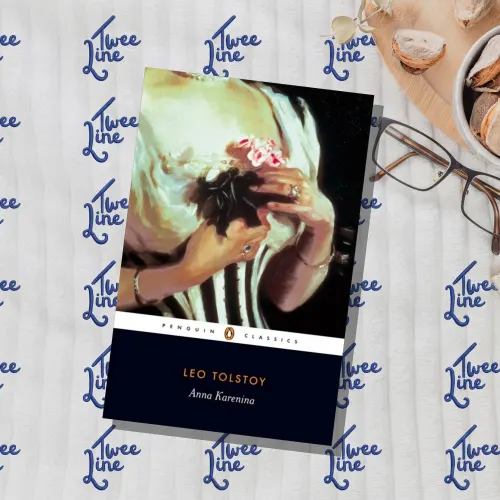





Anna Karenina
Tolstoy’s double story of a ruinous affair and a search for how to live.
Leo Tolstoy
Rs. 2,650.00
Sri Lankan goods, delivered to your door
Join Join our WhatsApp channelTimeless tales of faith, folly, and the human heart from a master storyteller.
In stock
A Lexicon collection of Leo Tolstoy's shorter fiction, gathering moral tales, peasant parables, and vivid character studies that showcase the Russian master's storytelling range.
Why read it
— Twee Line's take
Ask Tweeny about this book
Great Stories of Leo Tolstoy brings together a selection of the Russian writer's shorter fiction, the form in which he often worked with the most directness and moral clarity. These are not the vast battlefields and ballrooms of his novels but the smaller stages of village life, the roadside inn, the winter forest, and the quiet room where a person confronts his own conscience. The collection is designed for readers who want Tolstoy's storytelling power in concentrated doses, each story complete in itself yet connected by his abiding questions about how a person should live.
Tolstoy wrote across a long life, and his shorter works reflect that range. Some pieces here carry the sharp social observation of his early years, when he was already testing the boundaries between fiction and moral argument. Others belong to the later period when he turned increasingly to parables, folk tales, and stories written for ordinary readers. What unites them is a plainness of language that never feels simple, and a sympathy for flawed people that never slides into easy forgiveness or easy judgment.
At the center of these stories is the question of moral choice. Tolstoy is fascinated by the moment when a character must decide, often under pressure, often without full knowledge of the consequences. A merchant counts his money while a beggar waits outside. A landowner rides home through a blizzard and must reckon with his own pride. A peasant discovers that the smallest act of kindness can ripple further than any grand gesture. The stories rarely end with tidy resolutions; instead they leave the reader holding the weight of the decision.
Faith appears throughout, but not as doctrine. Tolstoy's spirituality in these pages is practical and restless. He is less interested in ritual than in whether a person actually loves his neighbor, feeds the hungry, and refuses violence. This gives the stories a searching quality. They ask the reader to examine his own life, not merely to admire the characters' virtues or pity their failures.
Another recurring theme is the gap between appearance and reality. Tolstoy loves to show a character who seems important, wealthy, or wise, then strip away the illusion to reveal fear, vanity, or emptiness underneath. Conversely, the humble figure, the servant, the old woman, the prisoner, often turns out to possess the insight the powerful lack. This reversal is one of his most reliable narrative pleasures, and it gives the collection a democratic spirit.
The tone shifts from story to story. Some pieces are warm and gently humorous, with a folk-tale rhythm that makes them suitable for reading aloud. Others are stark and unsettling, especially those dealing with death, guilt, or the cruelty people inflict on one another without thinking. A few have the compressed intensity of a fable, where every detail matters and the ending lands like a verdict.
What remains constant is Tolstoy's clarity. He writes sentences that a child could follow and an adult can ponder for years. There is little ornamentation, few metaphors for their own sake. Instead there is precise observation: the way snow gathers on a collar, the sound of a horse's hooves on frozen ground, the particular silence in a room after someone has told a lie. This concreteness is what makes the moral questions feel urgent rather than abstract.
Readers who come to Tolstoy through the novels will find here the same psychological penetration in miniature. Readers who are new to him will find an accessible entry point, since these stories demand less time and patience than the great doorstop volumes while still delivering the essential Tolstoy. The collection works well for short reading sessions, for travel, and for anyone who wants to end the day with a story that leaves something to think about.
This collection suits a wide range of readers. Students of Russian literature will appreciate seeing Tolstoy's development across different phases of his career. General readers who enjoy classic short fiction will find plenty to admire in the craftsmanship. Readers interested in moral philosophy, spirituality, or the literature of social conscience will discover in these pages a writer who refuses to separate art from ethics.
Because the stories are short and self-contained, the book is also a good choice for readers who have fallen out of the habit of finishing long books. Each piece offers a complete experience, and the variety of tone means the collection rarely feels repetitive. It can be read straight through or dipped into at random, and it rewards rereading, since the simplicity of the surface often hides considerable depth.
Tolstoy is one of the few writers whose work genuinely changes how readers see their own lives, and the shorter fiction is where that effect is most concentrated. A single story about a cobbler, a bishop, or a dying man can stay with a reader for decades. This collection gathers that power into one volume, making it a natural companion to the novels and a strong introduction for anyone who has not yet encountered him.
It also serves as a reminder that great literature does not need to be difficult. Tolstoy's plain style and deep humanity make these stories approachable without ever making them shallow. For a reader building a personal library of classics, this is a book that earns its place not by size or reputation alone but by the frequency with which it will be taken down and read again.
Leo Tolstoy was a Russian writer known for his realistic fiction and philosophical works. He is best known for his novels War and Peace and Anna Karenina, which explore themes of society, morality, and human experience. His later works, such as The Kingdom of God Is Within You, reflect his Christian anarchist beliefs.
Tolstoy’s double story of a ruinous affair and a search for how to live.
Leo Tolstoy
A practical paperback pick for readers drawn to a clear and readable approach to its subject in The Death of Ivan Ilyich.
Leo Tolstoy
A practical paperback pick for readers drawn to a clear and readable approach to its subject in War And Peace (Grey Cover).
Leo Tolstoy
A practical paperback pick for readers drawn to a clear and readable approach to its subject in Anna Karenina.
Leo Tolstoy
Great Stories of Leo Tolstoy
Rs. 2,210.00
Your cart is empty
Start adding items to see them here.